Birth Charts
How to Read Your Birth Chart: A Complete Beginner’s Guide
Learn how to read a natal chart step by step, including planets, signs, houses, aspects, angles, chart patterns, and practical interpretation.
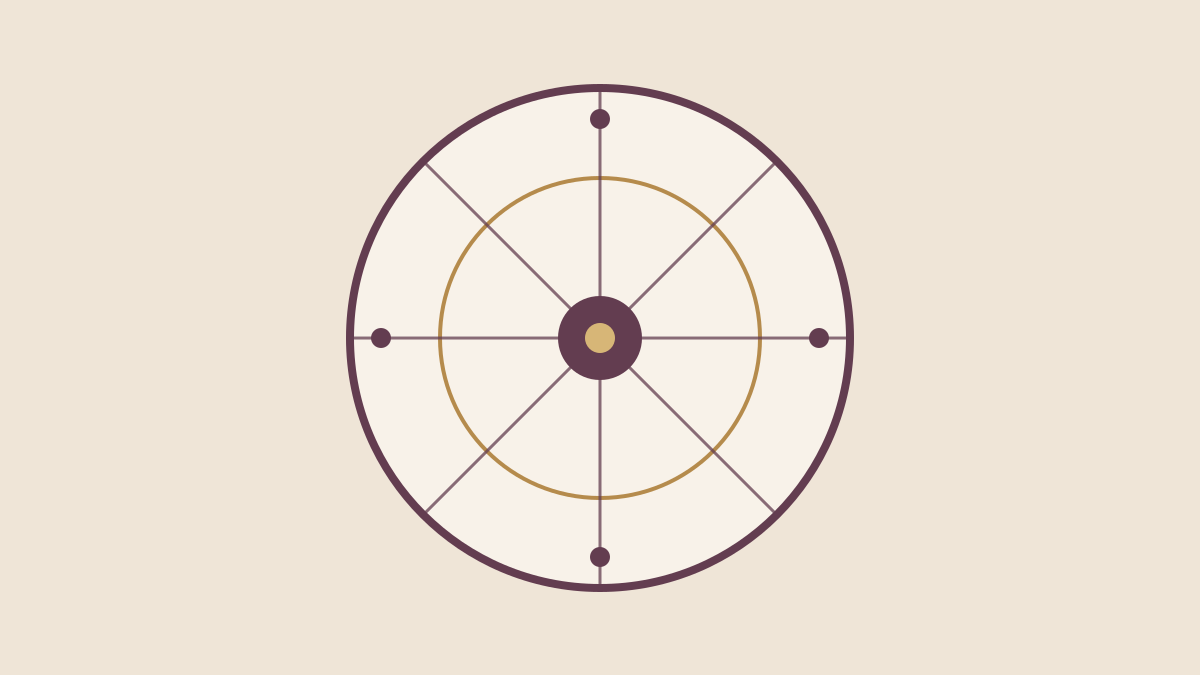
What a birth chart actually represents
A birth chart, also called a natal chart, is a symbolic map of the sky for the date, exact time, and location of a person’s birth. Astrologers use it as a framework for describing temperament, motivations, recurring life themes, developmental challenges, and areas of potential. It is not a fixed script. A chart describes patterns and possibilities, while choices, circumstances, culture, health, opportunity, and personal effort still matter.
The chart is organized through four main layers: planets describe what part of the psyche is acting; signs describe how that energy expresses itself; houses describe where in life it tends to operate; and aspects describe how different parts of the chart cooperate or create tension. Good interpretation combines all four rather than reading one placement in isolation.
Start with the three foundational placements
The Sun represents identity, vitality, purpose, and the qualities a person is learning to embody consciously. The Moon describes emotional needs, instinctive reactions, habits, memory, and the conditions that create a sense of safety. The Ascendant, or rising sign, describes the style of approach used when meeting life, the first impression a person gives, and the structure of the entire house system.
These three placements often explain why someone does not fully identify with a generic description of their Sun sign. A serious Capricorn Sun with a playful Leo Moon and a sensitive Cancer Ascendant may appear warm and protective, crave appreciation, and still organize life around achievement and responsibility.
Understand the planets
The personal planets are the Sun, Moon, Mercury, Venus, and Mars. Mercury describes thinking and communication. Venus describes values, attraction, relating, pleasure, and aesthetic preference. Mars describes desire, initiative, anger, courage, and how energy is directed.
Jupiter and Saturn are often called social planets. Jupiter expands, teaches, inspires, and shows where confidence and opportunity can grow. Saturn concentrates, tests, matures, and asks for discipline, boundaries, mastery, and accountability.
Uranus, Neptune, and Pluto move slowly and shape generations, but their house placements and close aspects make them deeply personal. Uranus disrupts and liberates. Neptune dissolves boundaries and heightens imagination, spirituality, longing, and confusion. Pluto intensifies, exposes, transforms, and brings power dynamics to the surface.
Read signs as styles, not stereotypes
Each sign represents a style of expression. Fire signs act through inspiration and direct experience. Earth signs prioritize practicality, stability, and tangible results. Air signs process through ideas, relationships, and communication. Water signs respond through emotion, intuition, and sensitivity.
Modes add another layer. Cardinal signs initiate, fixed signs sustain, and mutable signs adapt. A planet in a sign should be interpreted as a function expressed through that sign’s element and mode. Mars in Taurus, for example, may act slowly but persistently, while Mars in Aries may act rapidly and directly.
Use houses to locate the life area
The first house concerns identity, body, appearance, and approach. The second concerns money, possessions, values, and self-worth. The third concerns communication, learning, siblings, and the immediate environment. The fourth concerns home, family, roots, and private life. The fifth concerns creativity, pleasure, romance, and children. The sixth concerns work routines, service, skills, and health habits.
The seventh house concerns partnership and one-to-one relationships. The eighth concerns intimacy, shared resources, loss, inheritance, debt, and transformation. The ninth concerns higher learning, belief, travel, publishing, and perspective. The tenth concerns career, reputation, leadership, and public contribution. The eleventh concerns friendship, community, networks, and long-term goals. The twelfth concerns solitude, the unconscious, closure, retreat, spirituality, and hidden patterns.
Interpret aspects as conversations
An aspect is an angular relationship between planets. A conjunction fuses energies. A sextile creates an opportunity that develops through participation. A trine allows energy to flow easily, although ease can become underused talent. A square creates friction that pushes growth. An opposition highlights polarity, projection, and the need for balance.
Focus first on close aspects involving the Sun, Moon, Ascendant ruler, Mercury, Venus, Mars, Jupiter, or Saturn. A Moon-Saturn aspect can describe emotional restraint and early responsibility, while a Venus-Uranus aspect can describe a need for freedom, novelty, or unconventional relating.
Synthesize instead of collecting labels
Choose one major life question and trace it through the chart. For career, study the Midheaven, tenth house, its ruler, Saturn, the Sun, and the second and sixth houses. For relationships, study Venus, Mars, the Moon, the seventh house, its ruler, and major aspects. Repeating themes carry more interpretive weight than a single isolated placement.
End by translating symbolism into useful language. Instead of saying, “You have a difficult square,” say, “You may feel pulled between emotional security and achievement, and your growth involves building a life that supports both.” Astrology becomes valuable when it supports reflection, responsibility, and clearer choices.
Turn insight into personal guidance
Explore Saturn and Spice reports and oracle readings for a more personalized look at your chart, relationships, career, money themes, and upcoming cycles.
Explore readings and reportsContinue exploring
Related articles
For educational and entertainment purposes only. Astrology is not a substitute for medical, legal, financial, or mental-health advice.