Birth Charts
Astrological Aspects Explained: Conjunctions, Squares, Trines, Oppositions and More
A detailed guide to major and minor aspects, orbs, applying and separating aspects, aspect patterns, and practical chart interpretation.
What aspects show
Aspects describe relationships between planets. They reveal whether psychological functions blend, support one another, compete, or demand integration. A chart without aspect synthesis becomes a list of disconnected traits.
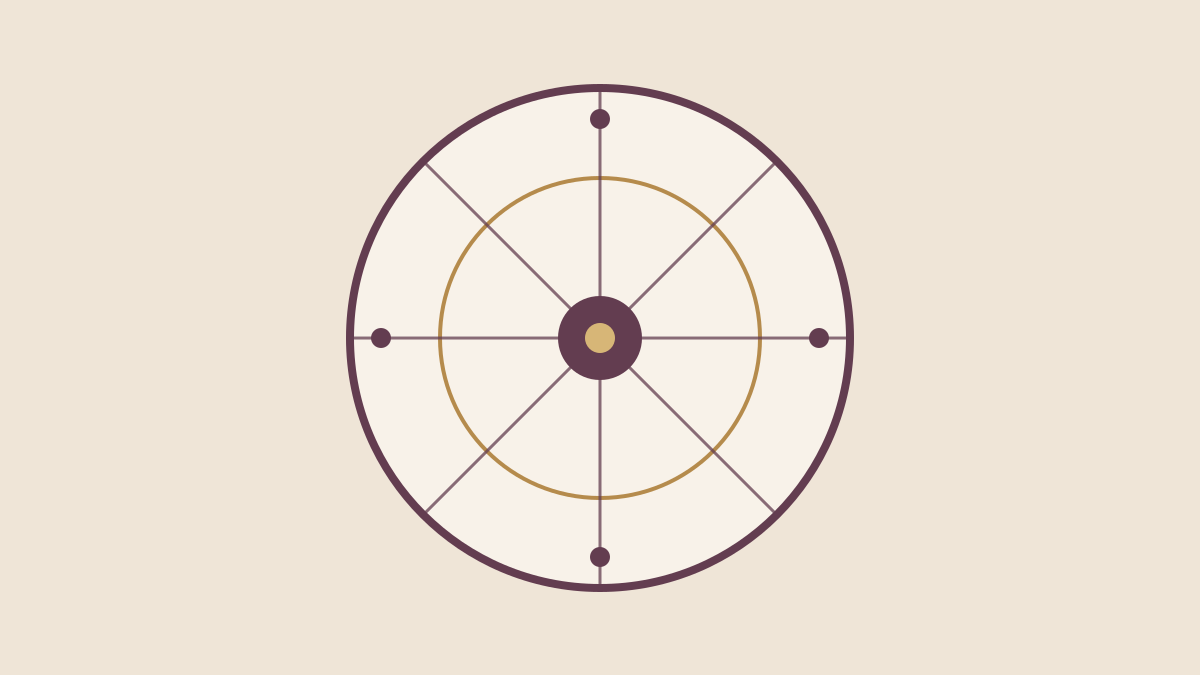
Angles are measured in degrees around the 360-degree zodiac. The closer an aspect is to exact, the more consistently it tends to operate. The acceptable distance from exactness is called an orb.
The conjunction
A conjunction occurs near zero degrees and merges two planetary functions. The result depends on the planets involved. Sun-Jupiter can amplify confidence and purpose, while Mars-Saturn may combine drive with restraint, endurance, frustration, or disciplined execution.
Conjunctions are neither automatically easy nor difficult. They create intensity and make the joined functions hard to separate.
The sextile and trine
A sextile is approximately 60 degrees. It indicates compatibility and opportunity, but it usually requires participation. Mercury sextile Saturn can support careful thinking, especially when the person deliberately develops planning and communication skills.
A trine is approximately 120 degrees and represents natural flow. Moon trine Venus may support emotional warmth and social ease. Trines can become strengths, but effortless qualities may be overlooked or taken for granted.
The square and opposition
A square is approximately 90 degrees and creates internal friction. It often pushes achievement because the person cannot remain comfortable indefinitely. Venus square Saturn may raise questions about worthiness, trust, affection, and boundaries, ultimately developing relational maturity.
An opposition is approximately 180 degrees. It creates awareness through contrast and often appears in relationships. The task is not to choose one side permanently, but to develop a conscious bridge between both.
Orbs and strength
Luminaries are often given wider orbs because the Sun and Moon are central. Minor aspects are generally read with tighter orbs. Different schools use different ranges, so consistency matters more than pretending there is one universal rule.
Prioritize exact aspects, aspects to angles, and repeated themes. A loose minor aspect should not outweigh an exact conjunction to the Ascendant.
Applying, separating, and planetary condition
An applying aspect moves toward exactness at birth and is often experienced as building or urgent. A separating aspect has already perfected and may feel familiar, established, or inherited. This distinction is especially useful in traditional and predictive work.
Sign dignity, house placement, retrograde motion, speed, combustion, and rulership can modify expression. Aspect meaning should be interpreted inside the whole chart rather than treated as a standalone verdict.
Aspect patterns
A T-square contains two squares and an opposition, producing pressure that demands action. A grand trine links three planets by trine and can create talent, self-sufficiency, or inertia. A grand cross produces sustained tension across four areas. A yod involves two quincunxes connected by a sextile and often symbolizes ongoing adjustment.
Patterns matter when the orbs are reasonably close and the planets are personally significant. Their value lies in showing how several parts of the chart operate as one system.
Turn insight into personal guidance
Explore Saturn and Spice reports and oracle readings for a more personalized look at your chart, relationships, career, money themes, and upcoming cycles.
Explore readings and reportsContinue exploring
Related articles
For educational and entertainment purposes only. Astrology is not a substitute for medical, legal, financial, or mental-health advice.